GTA 6 No Disc Controversy Goes Global — Politicians in Two Countries Are Now Involved
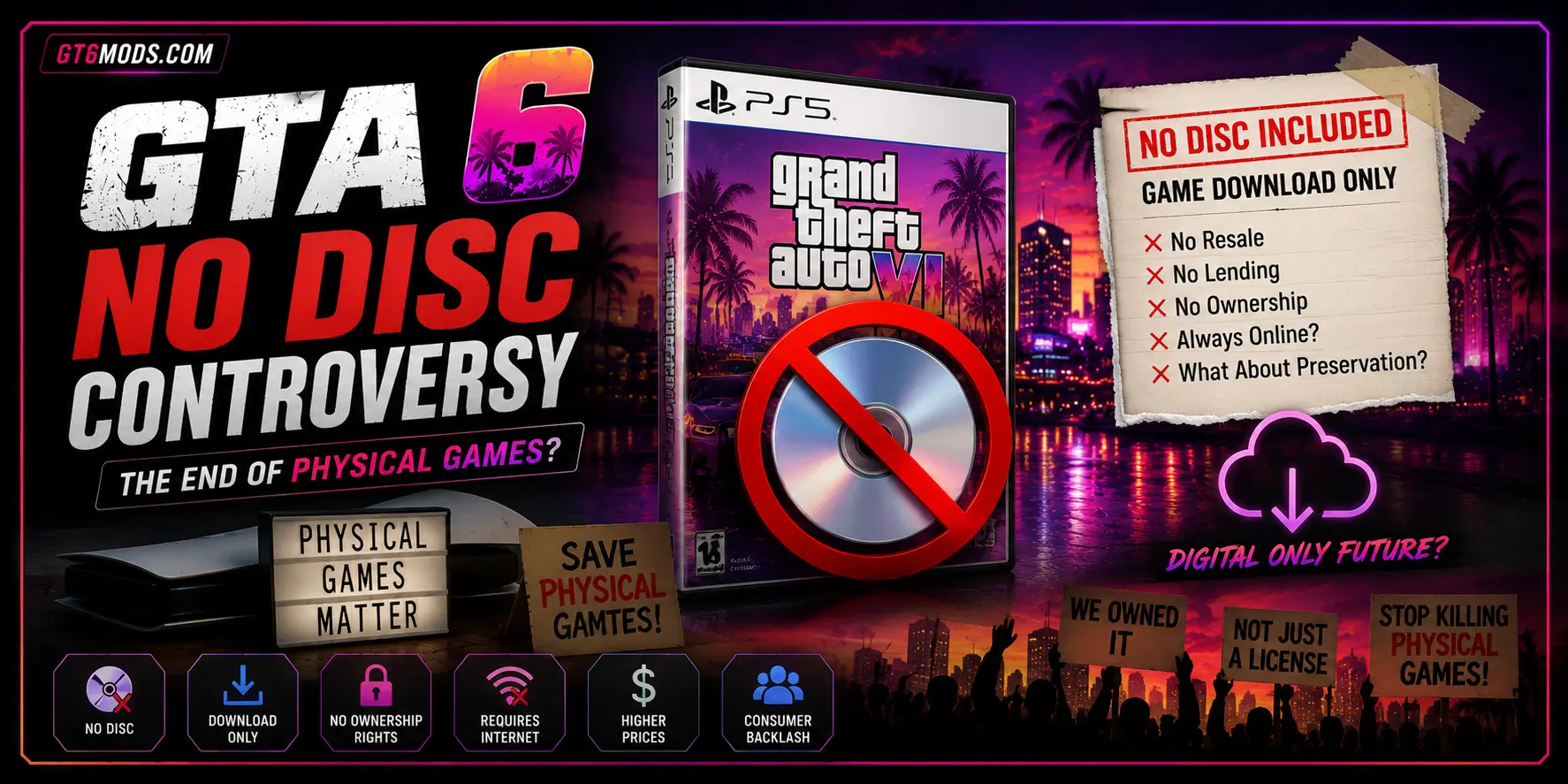
When Rockstar confirmed that GTA 6’s physical edition would contain a download code rather than a disc, the backlash was immediate and predictable. Players complained. Retailers pushed back. Two independent shops refused to stock the product entirely. That response was loud but contained within gaming circles.
Within two weeks, it wasn’t anymore. A French presidential candidate posted a manifesto about game ownership on X, citing GTA 6 specifically. A Brazilian federal deputy formally forwarded complaints to her country’s National Consumer Secretariat. An EU member of parliament added her voice. Xbox ran a Halo disc advertisement that was transparently a jab at Sony. GitHub offered to burn code to a CD-ROM.
The GTA 6 no disc controversy has stopped being a gaming story and started being something else.
What Started This: A Quick Recap
GTA 6’s physical Standard Edition, available from November 12 to allow pre-loading ahead of the November 19 launch, ships with a printed redemption code rather than a disc. Once redeemed, the game functions identically to a digital purchase: no resale, no lending, no offline installation from physical media.
Sony then announced that production of physical PlayStation game discs will end in January 2028, arriving shortly after GTA 6’s disc-free edition broke pre-order records. The two developments aren’t officially connected, but arriving in the same week made them easy to discuss together, and politicians in particular framed them as a single story about the direction the industry is heading. We covered the original no-disc announcement in detail in our GTA 6 no disc breakdown, including the confusing Rockstar Support email that briefly suggested a disc version was coming before that was clarified.
France: Jean-Luc Mélenchon and “Cultural Assets”
Jean-Luc Mélenchon is the leader of La France Insoumise, the left-wing French political party, and a serious political figure who finished third in France’s 2022 presidential election with nearly 22 percent of the first-round vote. He’s not a fringe voice. He’s a presidential candidate planning to run again in 2027.
On July 2, 2026, Mélenchon posted on X. Here’s his statement, translated from French:
“With GTA 6 without a disc in 2026 and Sony’s announcement of the end of physical disc sales for games in 2028, the question arises of how we view these products. Tomorrow, you will pay without ever owning anything. No loan, no resale, no guarantee of keeping what we’ve paid for. Video games are not mere merchandise — they are cultural assets, and the law in force must apply to them. We will open the project in 2027. Players have rights too!”
Several things in that statement are worth unpacking separately from the political framing.
The “cultural assets” argument is genuinely interesting and distinct from the usual consumer complaint. France has a long and serious legal tradition of treating certain creative works differently from ordinary commercial products, the country’s existing laws around book pricing and cinema support are examples of the state treating cultural goods as requiring special protection. Mélenchon is explicitly extending that framework to video games, which would have significant legal implications if pursued as policy. His reference to “opening the project in 2027” refers to a planned legislative initiative.
He also shared a petition to save physical video games alongside his post, suggesting this was a coordinated communications move rather than a spontaneous reaction.
A member of the European Parliament, Leïla Chaibi, separately added her own statement on the issue, giving the concern a presence at the EU level as well as the French national level. EU-level attention matters specifically because any meaningful regulation of companies like Sony or Rockstar would almost certainly need to operate at the European Union’s scale to have real legal reach over multinational corporations.
Brazil: Erika Hilton Goes Further
Brazilian federal deputy Erika Hilton didn’t just comment publicly. She formally forwarded complaints to Brazil’s National Consumer Secretariat, the government body responsible for enforcing consumer protection law. That’s a concrete action, not just a social media post.
Her arguments, laid out in her post on X, go beyond the general ownership question and address specific structural contradictions:
The hardware contradiction. PS5 consoles with disc readers are still being sold at a premium price. Consumers are paying extra for disc drive capability at the same time Sony is ending disc production and Rockstar is shipping a code in a box. You are paying more for hardware whose central function is being quietly deprecated. Hilton called this a direct inconsistency that puts consumers in a difficult position.
Ownership versus licensing. Digital games are licensed, not sold. When you buy a physical game you own a copy. When you redeem a code you have a revocable license. Most consumers don’t know the difference until something goes wrong, a store closes, a publisher is acquired, a service is discontinued.
The broader industry pattern. Hilton pointed to Microsoft’s consolidation, Sony’s disc exit, and Nintendo’s legal action against game preservation as connected signs of an industry moving away from consumer-owned collections and toward subscription models with ads and multiple pricing tiers.
She also added a personal note that cut through the political framing with genuine specificity: she has only one game in her library, GTA, which she plays specifically for the airplane mission. She said she does not accept this future.
Brazil’s context gives this more weight than it might carry elsewhere. The country has steep import taxes that make consoles and games significantly more expensive than in most markets. A used-game market isn’t a preference for Brazilian consumers, it’s often a financial necessity. The ability to buy, sell, and lend physical copies has real economic significance in a way it doesn’t in cheaper markets.
The GTA 6 No Disc Controversy as a Bigger Symbol
Something specific happened here that’s worth naming directly. GTA 6 became the symbol of the disc debate not because it’s the worst offender by any objective measure, but because of its scale.
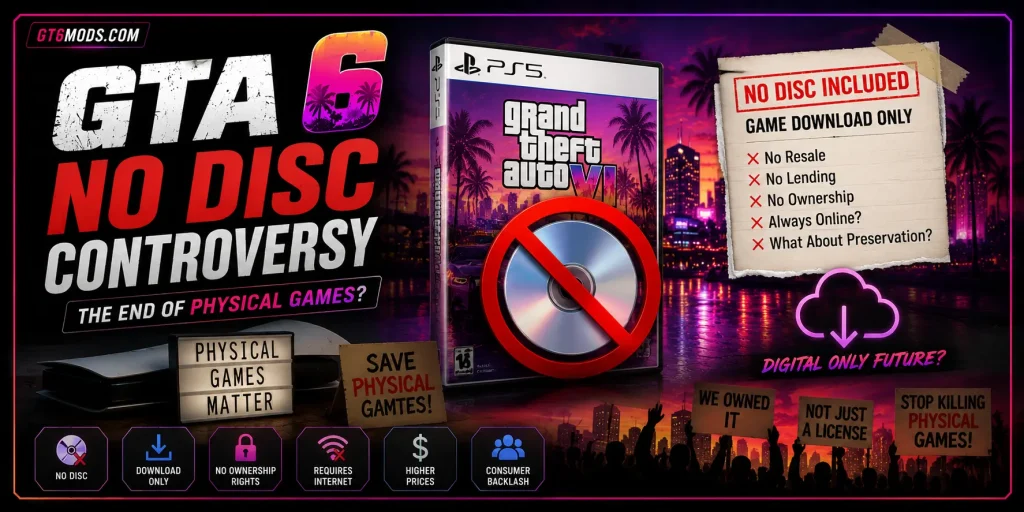
Pre-order records, billions in projected revenue, the most anticipated game launch in years. When the game everyone is watching ships without a disc, it crystallizes a trend that’s been building for years into a single, concrete, undeniable example. Politicians can point to it. Their constituents understand what GTA 6 is. The abstraction of “digital ownership” becomes “you bought GTA 6 and you don’t actually own it.”
That’s a more powerful political communication tool than citing a smaller, less-known game’s digital policy. Mélenchon’s comment has been shared and discussed far beyond French gaming media, and Hilton’s formal complaint has coverage in outlets that don’t normally cover gaming at all. The scale of GTA 6 is precisely what made this a mainstream political story rather than a niche consumer gripe.
How the Rest of the Industry Responded
Sony went quiet on social media as the storm rolled through, which is its own kind of statement given how active Sony’s channels normally are.
Xbox moved in the opposite direction. Within days of Sony’s disc announcement and GTA 6’s no-disc launch, Xbox ran a Halo: Campaign Evolved advertisement that prominently featured a physical disc as a selling point. The subtext was impossible to miss. Xbox has made plenty of its own anti-consumer decisions over the years, including heavy investment in digital and Game Pass, but the marketing opportunity here was real and they took it.
GitHub, the code hosting platform owned by Microsoft, joined in with a stunt offering to burn code to a CD-ROM. Whether that was genuinely supportive of physical media or just opportunistic brand trolling is a matter of interpretation, but it shows how far the story spread beyond gaming.
What Actually Changes
Being honest about this requires separating the political noise from the practical outcome.
No politician’s statement will bring back a GTA 6 disc. Mélenchon’s project is planned for 2027, well after GTA 6 launches. Hilton’s complaint to the National Consumer Secretariat is the beginning of a process, not a result. EU-level regulation of digital ownership, if it ever happens, would take years of legislative work across 27 member states.
What has changed is the conversation. Digital game ownership has spent years as a concern raised by gaming enthusiasts and dismissed as niche. Within two weeks of GTA 6’s pre-orders opening, it was being discussed in a French politician’s policy platform, a Brazilian parliamentary complaint, and European Parliament statements. That’s a meaningful shift in who’s paying attention.
If you’re specifically interested in what this means for GTA 6’s modding future and the question of who actually owns what in the GTA ecosystem, our FiveM GTA 6 breakdown covers Rockstar’s official Cfx Marketplace and the broader question of how community-created content will be controlled going forward, which is a related ownership question the disc debate rarely addresses.
The Honest Picture
The GTA 6 no disc controversy went global because GTA 6 is the biggest game in years and because it arrived simultaneously with Sony confirming the end of PlayStation disc production. The combination created a moment where a trend that had been building quietly became impossible to ignore.
Politicians in France and Brazil cited it specifically and credibly, not as a gaming topic but as a consumer rights and cultural policy issue. Whether any of that produces real legal change depends on political processes that move slowly, and no disc-based version of GTA 6 is currently planned by Rockstar regardless of political pressure.
What’s already happened is the conversation moving. The question of what digital ownership actually means has left gaming forums and entered mainstream political discourse on two continents. That’s a development worth watching regardless of what it eventually produces.