GTA 6 Performance: What Digital Foundry Has Found So Far on PS5, PS5 Pro and Xbox
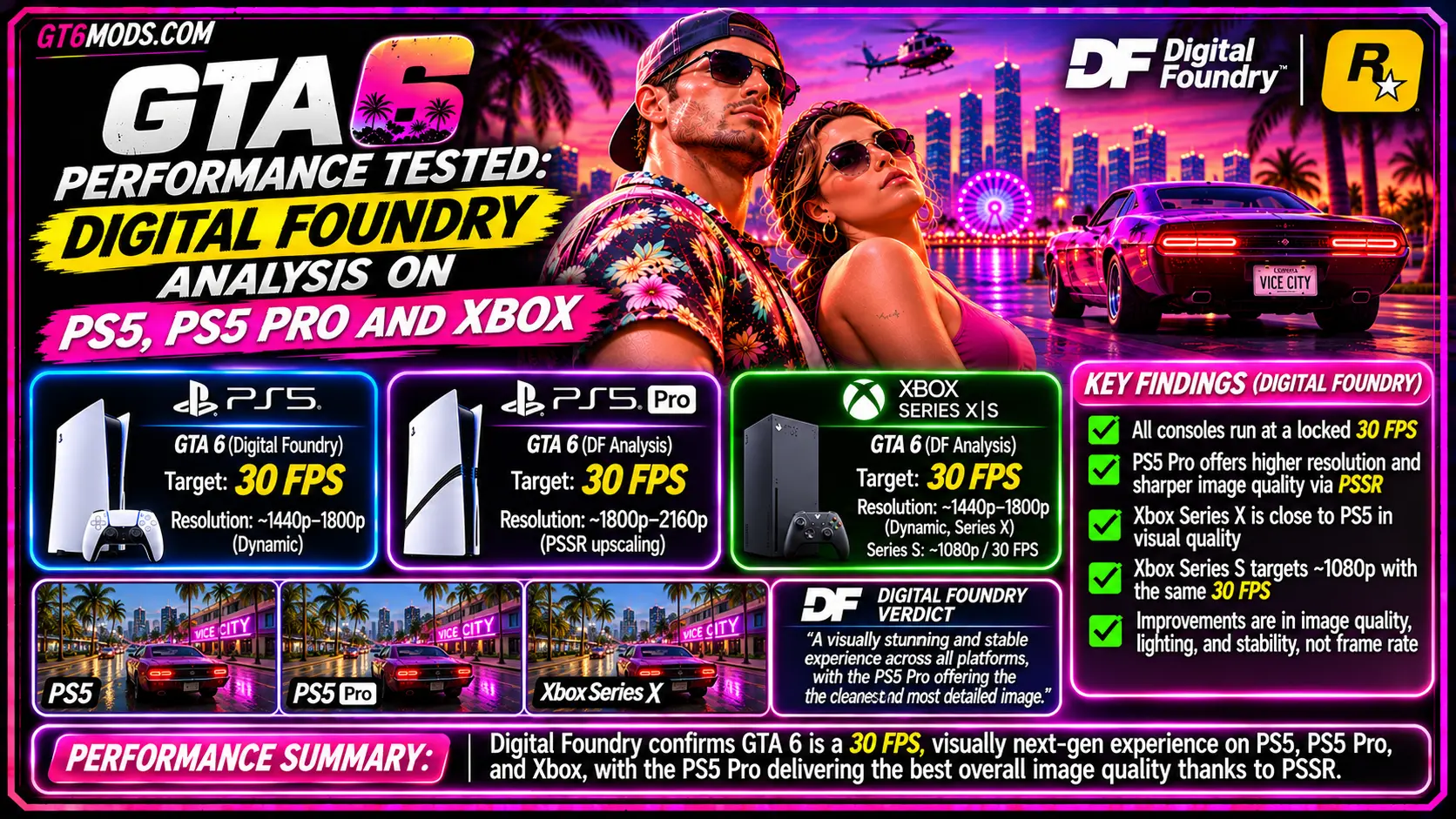
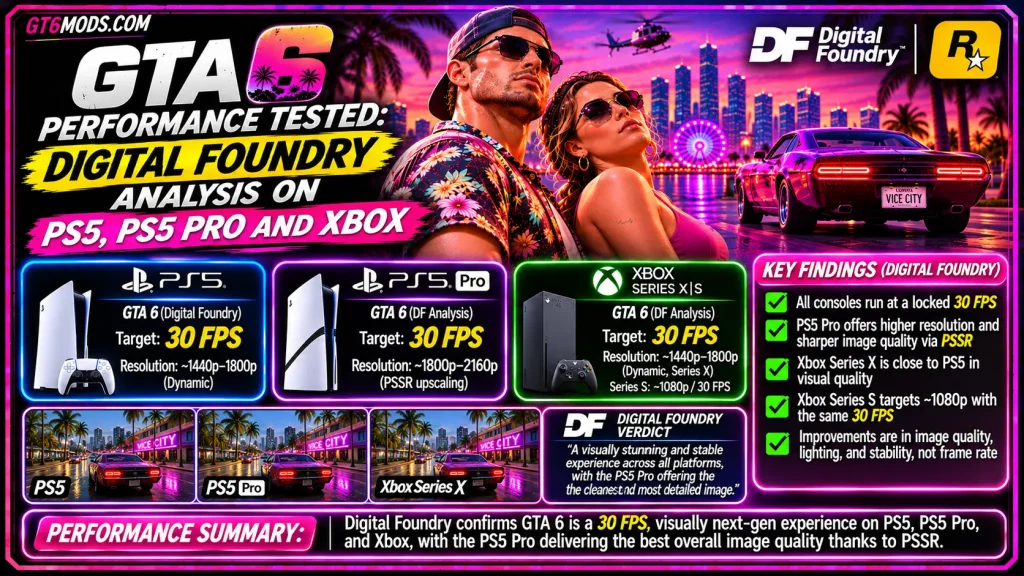
Digital Foundry has not yet tested the retail version of GTA 6. Its analysis of Rockstar’s extended gameplay footage, recorded on a base PS5, found a resolution of around 1440p upscaled to 4K and a mostly stable 30 FPS with occasional dropped frames. It expects the Xbox Series X to look nearly identical and the PS5 Pro to sit on top, but those are predictions, not measurements.
With launch five days away, people are searching for GTA 6 Digital Foundry results to find out how the game actually runs. The honest situation is that the full retail performance test does not exist yet. What does exist is a detailed look at pre-release footage, and it already tells us a lot.
This article explains what Digital Foundry found, what it means for each console, where the analysis falls short and what a full test should reveal. We checked it against reporting available on November 14, 2026, and we will update it when real results arrive.
What Digital Foundry Has and Has Not Tested
It helps to be exact here.
- What it analyzed: Rockstar’s extended gameplay look, about 26 minutes of footage recorded on a base PS5, plus earlier trailers and screenshots.
- What it has not published: a test of the finished game on PS5, PS5 Pro, Xbox Series X or Xbox Series S.
- What it predicted: how the other consoles should compare, based on hardware and the footage.
That is a meaningful difference. Footage chosen and released by the developer is a useful signal, but it is not the same as playing the retail game.
The Main Findings From the Footage
As summarized by several outlets, Digital Foundry’s analysis points to these results on base PS5:
- Internal resolution: about 2560 by 1440 pixels, with no sign of dynamic resolution scaling in the scenes shown.
- Output: a fairly plain upscale to 4K. The team saw no strong evidence of a modern temporal upscaler.
- Frame rate: mostly stable 30 FPS, with occasional dropped frames. Digital Foundry found a tighter lock to 30 than in earlier Rockstar games.
- Image quality: some softness, jagged edges on geometry and shimmer on fine detail, which are common side effects of that kind of upscaling.
- Lighting: ray-traced effects were identified. Summaries mention reflections and global lighting, and note that the reflections can look noisy in places.
- Motion: at times, camera movement and animation looked uneven even while the frame rate held.
Notebookcheck’s report on Digital Foundry’s analysis of the PS5 footage covers how the team reached its view on frame rate.
What This Means for the Base PS5
If the retail game looks like the footage, the standard PS5 version is a 1440p image, upscaled to 4K, at 30 FPS. That is consistent with Rockstar’s November 10 statement that it is targeting 30 FPS on all consoles.
It also fits what players are likely to notice. Many will see a dense, detailed world with a soft image and some shimmer, rather than a razor-sharp picture. Whether that bothers you depends on your screen and how close you sit.
What to Expect on PS5 Pro
Rockstar has confirmed two PS5 Pro extras: PSSR upscaling for improved clarity, and ray-traced shadows that no other console gets. It has not published resolutions.
Digital Foundry expected the Pro to sit on top of the other consoles and to gain image quality, which fits those features. The size of the gain is unknown, and no one has compared Pro footage yet. We explain the two features in our guide to GTA 6 PS5 Pro features.
What the Pro will probably not do is run faster. Digital Foundry has argued for months that the Pro’s processor is only slightly quicker than the base PS5’s, which limits the frame rate.
What to Expect on Xbox Series X and Series S
Digital Foundry expected the Xbox Series X to land in similar territory to the base PS5, in its words close to identical, with the Series S at a lower level. That is a prediction from the hardware and not a test result.
Rockstar has confirmed a 30 FPS target on both Xbox consoles, listed no Xbox-exclusive graphics features and has not published a resolution for the Series S. According to Vice, the game will also be available through Xbox Cloud Gaming using settings based on the Series S.
Why Digital Foundry Thinks 60 FPS Is Unrealistic
The main argument is about the processor. At 30 FPS, the console has about 33.3 milliseconds per frame. At 60 FPS, it has about 16.7. GTA 6 packs a lot of people, traffic, weather and physics into each frame, and lowering the resolution does little to help the processor.
Digital Foundry has suggested that a 40 FPS mode on 120 Hz displays could be a more realistic middle ground, though it described that as informal speculation. Rockstar has not announced any extra mode. See our articles on GTA 6 60 FPS and on whether a PC version could reach 60 FPS for more.
Limits of This Analysis
Treat the findings with care. They have real limits.
- Rockstar chose the footage. The scenes were selected to look good, and may not show the heaviest areas.
- Compressed video can hide problems. Digital Foundry noted that a 30 FPS video asset could conceal additional dropped frames.
- It was a pre-release build. The final game may be tuned differently, and patches can change performance.
- Only one console was shown. Everything about the Pro and Xbox is inferred.
- Estimates are not specifications. The 1440p figure is Digital Foundry’s own measurement of the footage, not an official number from Rockstar.
What a Full Retail Test Will Add
When Digital Foundry or other outlets test the finished game, these are the questions that matter most:
- How steady is 30 FPS in the busiest parts of the city, in traffic and in rain?
- How much sharper is the PS5 Pro in practice, and how noticeable are the ray-traced shadows?
- How close are the Xbox Series X and PS5 in real play?
- How does the Series S compare, and is the resolution acceptable?
- Are load times quick, and does the day-one patch change anything?
- Does motion feel smooth, or do uneven animations show up?
Digital Foundry has not said when its retail test will appear. Reviews are reportedly due on November 18, and technical analysis may follow around launch. Our article on the GTA 6 review embargo has the reported schedule.
What to Check When the Full Test Lands
- Frame rate stability, not just the target.
- Resolution on your console, since the Pro and Series S may differ.
- Image artifacts, such as shimmer and noisy reflections.
- Version differences, such as Pro-only features and Xbox settings.
- Patch notes, which could change results after launch.
What About PC?
Rockstar has not announced a PC version, so there is no performance data. Digital Foundry has warned that even a PC version could find 60 FPS challenging and may need a recent high-end processor. That is a caution, not a measurement.
Other Terms You Will See
Technical coverage uses several phrases for the same ideas:
- Internal resolution, native resolution: the size of the image the game actually draws.
- Spatial upscale, temporal upscale: two ways of enlarging that image. Temporal methods use data from past frames.
- Frame time, frame pacing: how evenly frames arrive, which affects smoothness.
- Dynamic resolution scaling: lowering resolution on the fly to protect the frame rate.
Open Questions
- How does the retail game compare with the footage Rockstar released?
- What resolution will the PS5 Pro and Xbox Series S use?
- How stable will the frame rate be in the worst scenes?
- Will a day-one patch change performance?
- When will Digital Foundry publish its full test?
The Bottom Line on GTA 6 Digital Foundry Findings
The GTA 6 Digital Foundry analysis so far points to roughly 1440p, upscaled to 4K, at a mostly stable 30 FPS on a base PS5. The Xbox Series X is expected to be close, and the PS5 Pro should look better, but none of that has been tested on the retail game.
When real performance tests arrive, we will update this page with the results. Until then, treat these findings as a strong early guide, not a final verdict.