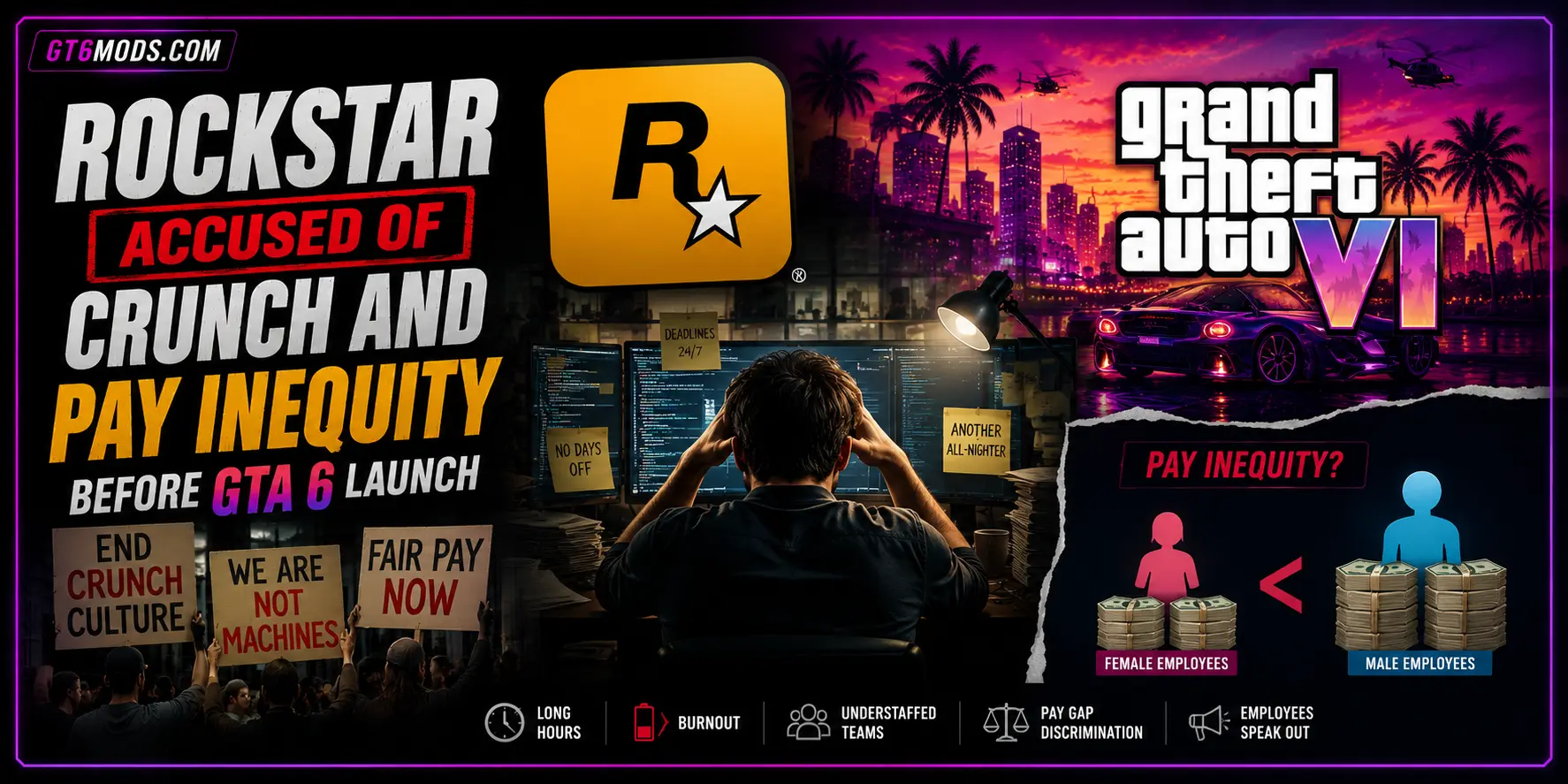
Rockstar Accused of Crunch and Pay Inequity Before GTA 6 Launch — What We Know
On July 1, 2026, Game Developer published an interview with three members of the Rockstar Game Workers Union who spoke on condition of anonymity. Their accounts covered crunch built directly into employment contracts, bonus structures they described as deliberately opaque and often disappointing, a widening gender pay gap, and a return-to-office mandate that sources say didn’t apply equally to company leadership.
Rockstar Games had not publicly responded to the specific allegations in the Game Developer report as of this writing. Take-Two Interactive also issued no public statement. That absence is worth noting, since what follows is based entirely on the union members’ accounts as reported by Game Developer, and Rockstar’s perspective on these specific claims isn’t on record.
Here’s what the report actually says, with the sourcing kept clear rather than presented as settled fact.
The Context: RGWU Recognition and Timing
The Game Developer report published one day after the Rockstar Game Workers Union formally submitted a filing to be recognized by Rockstar Games. That timing is relevant context. Union recognition filings in the UK trigger a formal process, and the workers who spoke to Game Developer did so as part of a broader push to put their working conditions on record ahead of that recognition process.
Rockstar has since confirmed it will engage in conversations with the union regarding official recognition. If recognized, Rockstar North would become only the second game developer in the UK to formally recognize a union. Gaining formal recognition would give workers collective bargaining rights they currently don’t have, including the ability to negotiate pay structures, bonus schemes, and working hours at an institutional level rather than through individual conversations with management.
The workers who spoke to Game Developer were specifically identified as not among the employees reportedly dismissed in October 2025 over alleged union efforts. That distinction matters: these are current employees raising concerns about ongoing conditions rather than former staff with potential grievances about their departures.
Rockstar Pay Inequity GTA 6: What the Union Members Actually Said
The Game Developer report covers four distinct areas of concern. Here’s each one, with the sourcing clearly attributed to the union members’ accounts rather than presented as independently verified fact.
Bonus Opacity and What Union Members Call “Weaponized” Compensation
The most specific allegation in the report concerns how bonuses function at Rockstar. A considerable portion of most employees’ total compensation package comes in the form of bonuses rather than base salary. According to the union sources, those bonuses fluctuate significantly and without clear explanation.
One source described it directly: “When the bonus is particularly good, it can be a windfall, but often the bonus is disappointing and one can end up being paid considerably less than expected for the year.”
The structural concern the union raises goes beyond the variability itself. Because bonuses are discretionary and Rockstar is under no contractual obligation to explain how they’re calculated, sources argue the system creates leverage over individual employees. As one source put it: “The main problem is that bonuses and progression are all completely discretionary for the company, and they are under no obligation to show their working. Employees want good pay, and if literally anything they do that year could affect it, they will naturally feel they have to be as pliable as possible to their boss’s whims. Imagine how you might feel if a fifth of your salary could be withheld without any justification or based on a single surprise factor.”
The union sources also reported that total compensation at Rockstar frequently falls below market rate for comparable roles in adjacent industries when the bonus comes in below expectations, making the variability a financial planning problem as well as a morale one.
Career progression is described as similarly opaque. Sources say promotions are difficult to secure because the goalposts for advancement are regularly shifted without clear communication.
Crunch Written Into Contracts
The report’s most concrete detail concerns how crunch operates at Rockstar. Under UK employment law, the Working Time Regulations limit employers from requiring employees to work more than 48 hours per week on average, or approximately 10 extra hours per week beyond a standard working week. Employees can voluntarily opt out of this protection, and crucially, Rockstar’s employment contracts reportedly include this opt-out as standard rather than as an active choice employees make separately.
One source described the practical reality: “Crunch is prevalent enough that the company built into our contracts, as standard, an opt out of the Working Time Regulations that stops your employer being able to ask you to do more than about 10 hours extra each week.”
The RGWU has reportedly had some success on this front: a campaign to inform employees that they could opt back into the Working Time Regulations at any time has led to Rockstar simplifying that process, removing the requirement of an HR meeting that previously existed. The union sources cited that as a concrete win, even while describing the broader crunch culture as ongoing.
One important nuance the report includes: crunch is not universal across Rockstar’s teams. Sources describe a highly compartmentalized studio where some teams apparently never experience crunch while others seem to exist in a permanent state of it, and many employees don’t know which situation their colleagues are in. “Often colleagues do not realize the opposite group exists,” one source said.
The union sources also took issue with how Rockstar frames overtime compensation: “Part of the problem with crunch is that there is not an agreed definition, and now it seems the company thinks that offering specific and limited compensation as an incentive for overtime means it no longer qualifies as crunch.”
The Gender Pay Gap
The report includes a specific claim about gender-based pay inequity that has widened at Rockstar. Union sources told Game Developer that the gap between median wages for different genders has increased, and that initiatives Rockstar had in place specifically to address this imbalance have been scrapped.

This is a more serious structural allegation than the bonus opacity complaints, since UK law requires companies of a certain size to report gender pay gap data publicly through the government’s mandatory reporting framework. Whether Rockstar’s public gender pay gap data reflects the internal conditions the union members describe is a separate question the report doesn’t resolve directly.
The Return-to-Office Mandate
Workers also described a return-to-office mandate that required employees to give up hybrid and remote working arrangements. Sources claim this requirement did not apply equally to company leadership, creating a visible disparity in working conditions between staff and management.
This detail connects to a broader documented history. Rockstar enforced a return-to-office policy from 2024, which IGN and other outlets reported at the time was partly driven by the security concerns following the 2022 data breach that exposed GTA 6 development footage. Several Rockstar developers publicly criticized the mandate when it was implemented.
Why This Matters More Than Another “Crunch” Story
Rockstar has faced crunch allegations before. The development of Red Dead Redemption 2 in 2018 triggered a widely covered industry conversation about working conditions, after a Dan Houser interview referenced 100-hour work weeks. The backlash was significant enough that Rockstar issued a clarification and the studio reportedly made genuine internal changes.
What makes the July 2026 report different is the institutional dimension. The existence of a formal union filing, the specific and structural nature of the allegations (contract-level opt-outs, scrapped equity initiatives, discretionary compensation with no accountability mechanism) and the timing five months before GTA 6 launches all place this in a different category from individual developer accounts of overwork.
The union recognition process now underway is also the first formal attempt to give Rockstar employees collective leverage over these conditions rather than relying on individual accounts or public pressure. The outcome of that process, specifically whether Rockstar formally recognizes the RGWU, will matter more for the long-term picture than any single report.
What Hasn’t Been Said
Several things are worth being explicit about, since reporting on allegations requires being clear about what’s confirmed versus what isn’t.
Rockstar has not publicly responded to the specific claims in the Game Developer report. The accounts come from three anonymous union members, which is a small sample in a studio that employs thousands. The Game Developer report itself is the original primary source, and all subsequent coverage, including this article, is drawing from that single interview. The claim that crunch varies significantly by team is worth taking seriously as context, since it complicates a blanket picture of the studio’s conditions.
None of this means the allegations aren’t credible or worth covering. Anonymous sourcing from people who express fear of reprisal is a normal and legitimate journalistic practice for exactly these kinds of workplace accounts. It simply means the complete picture of working conditions across a studio as large and compartmentalized as Rockstar is genuinely unknown from outside, and that uncertainty belongs in the coverage rather than being papered over.
The Broader GTA 6 Development Context
This report lands at a genuinely consequential moment. GTA 6 is five months from release. The October 2025 dismissal of 34 employees over alleged information leaks, the 2022 security breach, the return-to-office mandate, and now the union recognition filing and accompanying pay and crunch allegations form a picture of a studio under significant internal pressure during the final stretch of its most important release.
For a game expected to generate billions in its first year, the conditions under which the people making it are working is a legitimate subject of public interest. The Kortz Center Heist just launched in GTA Online as the probable final major update before GTA 6, which we covered separately in our GTA 5 Kortz Center Heist breakdown. Both stories reflect the same reality: GTA 6’s launch window is now genuinely close, and everything happening around Rockstar right now sits in that context.
If you’re following GTA 6’s development timeline specifically, our GTA 6 PC release date breakdown covers what’s confirmed about the November 19 launch and the still-unconfirmed PC version.
Where Things Stand
Three members of the Rockstar Game Workers Union spoke to Game Developer on July 1, 2026, alleging crunch embedded in employment contracts, discretionary bonus structures they describe as opaque and used as leverage, a widening gender pay gap after equity initiatives were scrapped, and a return-to-office mandate that sources say wasn’t applied equally to leadership. Rockstar had not publicly responded to these specific claims as of this writing.
The union recognition process now underway will matter more than any individual report. If Rockstar formally recognizes the RGWU, the collective bargaining that follows will address these conditions in a way that public accounts alone cannot. We’ll cover that development the moment it’s confirmed.