History of GTA Modding — From GTA 3 to GTA 6
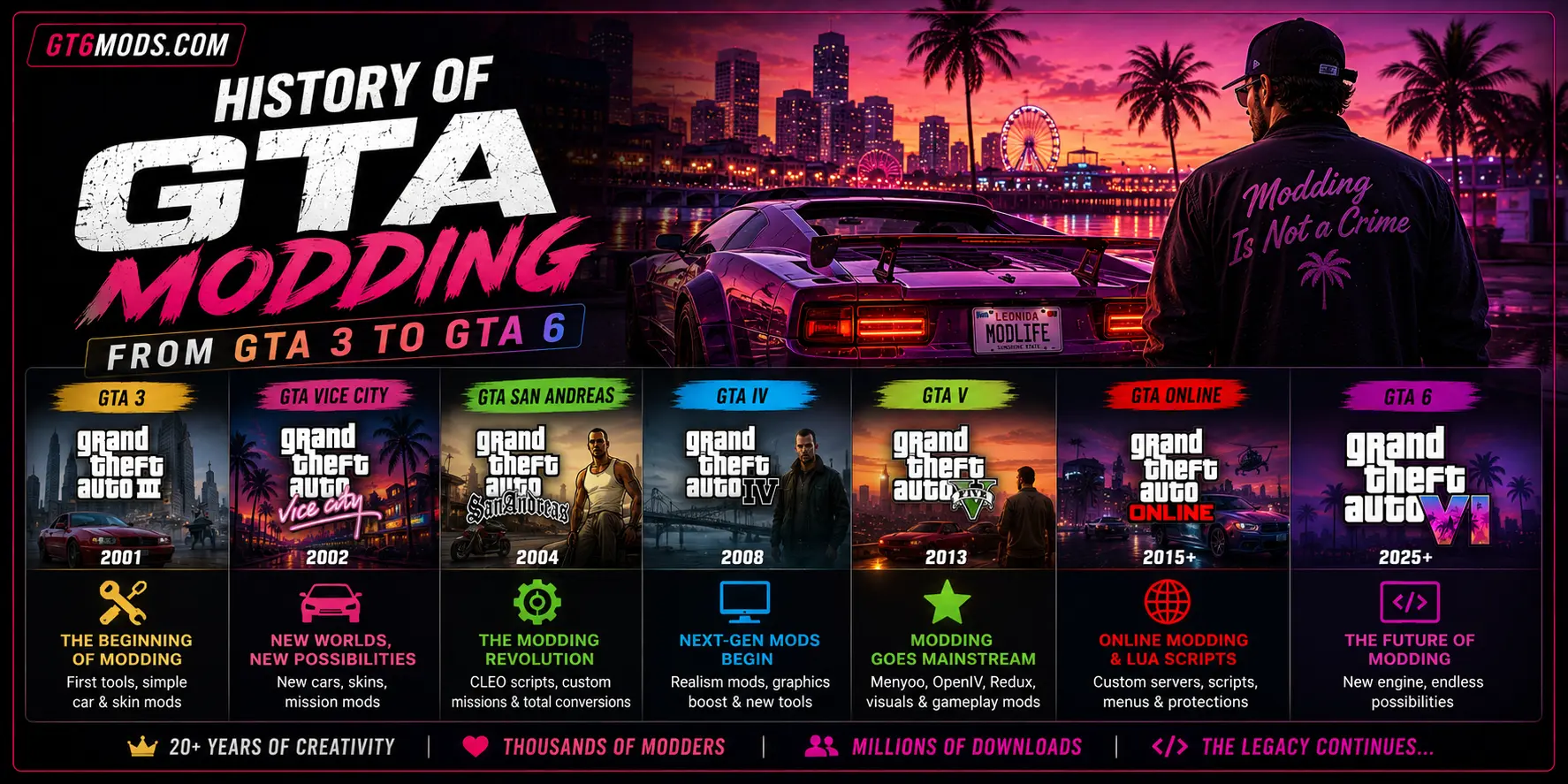
GTA mods history stretches back over two decades, from players swapping car textures in GTA 3 in 2001 to a community that has produced hundreds of thousands of mods, built entirely new multiplayer platforms, triggered congressional investigations, and watched Rockstar go from sending private investigators to a developer’s home to acquiring that developer’s company eight years later. No other game franchise has had a modding story quite like this one.
Here’s the full arc, told accurately rather than through the rose-tinted lens most retrospectives use.
GTA 3 (2001): Where It Actually Started
The GTA modding community didn’t start with GTA 5. It started with GTA 3 in 2001, when the game’s PC release gave players access to its files for the first time in the franchise’s history. The series had existed since 1997 in its top-down 2D form, but GTA 3’s shift to a fully 3D open world running on Renderware also meant a file structure that modders could actually reach with the tools available at the time.
The earliest GTA 3 mods were simple by later standards: vehicle texture replacements, skin swaps, and small map alterations. But they established the fundamental pattern that would define GTA modding for the next two decades. Players wanted to bring real-world vehicles into the game. They wanted to change how characters looked. They wanted to push the game’s world beyond what Rockstar had built. The tools were primitive, the modding was laborious, and the community was small, but the appetite was real from the very beginning.
One of the first notable community achievements was the recreation of GTA 3’s Liberty City within the Vice City engine, demonstrating that modders could do significant cross-title work even with the limited tools of the early 2000s.
Vice City (2002) and San Andreas (2004): The Scene Takes Shape
GTA Vice City arrived in 2002 and brought with it Vice City Mod Manager, one of the first dedicated mod management tools built specifically for a GTA title. It used its own VCM file format and gave players a more structured way to install and manage mods rather than directly swapping files by hand. This was a small step, but it mattered: making modding more accessible meant a larger pool of people who could participate in it.
GTA San Andreas in 2004 is where GTA mods history gets genuinely complicated, and not just because the game was the largest and most mod-friendly GTA title to date. San Andreas introduced character customization, a massive three-city map, and a file structure that modders found more accessible than previous entries. The modding scene grew significantly around it.
Then came Hot Coffee.
In June 2005, Dutch modder Patrick Wildenborg, working under the name PatrickW, released a patch called “Hot Coffee” on GTAGarage.com. It didn’t add new content. It unlocked a sexual minigame that Rockstar itself had built, then disabled before launch, leaving the code sitting in the game’s files. Wildenborg found it, edited a single code bit in the game’s main.scm script file with a hex editor, and uploaded the result. It was downloaded over a million times in four weeks.
The fallout was unlike anything the gaming industry had seen. The ESRB re-rated San Andreas from M to AO on July 20, 2005. Walmart, Target, Best Buy, and GameStop pulled the game from their shelves. Australia banned it outright. Senator Hillary Clinton and others in Congress called for federal investigations. The Family Entertainment Protection Act was introduced. Take-Two’s stock dropped and the company faced a class action lawsuit that eventually settled for $20 million.
Dan Houser later said in an interview that Rockstar genuinely feared the company would shut down. “The company nearly imploded,” was how he described it. Rockstar released a “Cold Coffee” patch removing all the hidden content, rereleased the game in a cleaned-up version, and spent the next several years being significantly more cautious about what content made it into final game builds.
What Hot Coffee actually demonstrated, beyond the controversy, was how much power modders had to expose things developers had left in their games. It permanently changed how the games industry thought about hidden content and ESRB submissions.
GTA 4 (2008): Script Hook and the Modern Era Begins
GTA 4 launched in 2008 on a new engine, RAGE, which gave modders a significantly more complex system to work with than San Andreas’s Renderware. Progress was slower than it had been with previous titles, but GTA 4 is where two developments happened that defined modern GTA modding.
The first was the emergence of Script Hook for GTA 4, built by developer Alexander Blade. Script Hook gave custom code direct access to the game’s internal script functions, allowing modders to write scripts that could change game behavior in ways that texture and model swaps never could. This was the foundational concept that would later power Script Hook V for GTA 5 and drive the entire category of gameplay-modifying mods.
The second was the early development of OpenIV, a tool specifically built to handle GTA 4’s RAGE archive format. OpenIV let modders open the game’s internal files without the brute-force approaches that earlier GTA modding had required, and it was clean, reliable, and maintained by a dedicated team. Alexander Blade was directly involved in its development, adding to the same body of work that would define GTA 5 modding for a decade.
GTA 4’s map mods also established another community tradition: attempts to recreate other GTA cities within the game engine. Liberty City and Alderney’s detailed HD urban environment made it particularly well-suited for this kind of work, and the tradition of bringing old GTA locations into new game engines has continued into GTA 5.
GTA 5 (2013-Present): A Decade That Changed Everything
GTA 5 launched on PS3 and Xbox 360 in September 2013. The PC version arrived in April 2015, and what followed was the most sustained and productive modding period in the franchise’s history by any measure.
Script Hook V, Alexander Blade’s evolution of the GTA 4 tool, arrived quickly after the PC launch and immediately became the foundational layer for almost all gameplay modding. Without it, nothing else worked. Blade has maintained it through dozens of GTA 5 updates over more than a decade, typically releasing compatibility updates within days of each Rockstar patch. That consistency is not something to take for granted: Script Hook V’s sustained maintenance is the primary reason GTA 5’s modding ecosystem has remained viable for so long.
OpenIV matured into the definitive tool for file and archive editing, enabling vehicle mods, texture replacements, audio swaps, and map modifications at a scale the GTA modding community had never previously achieved. The combination of Script Hook V and OpenIV, plus the scripting layer Script Hook V .NET that allowed mods to be written in C# rather than raw C++, produced a modding ecosystem capable of supporting everything from simple car replacements to sophisticated new game modes, superhero scripts, and realistic police overhauls.
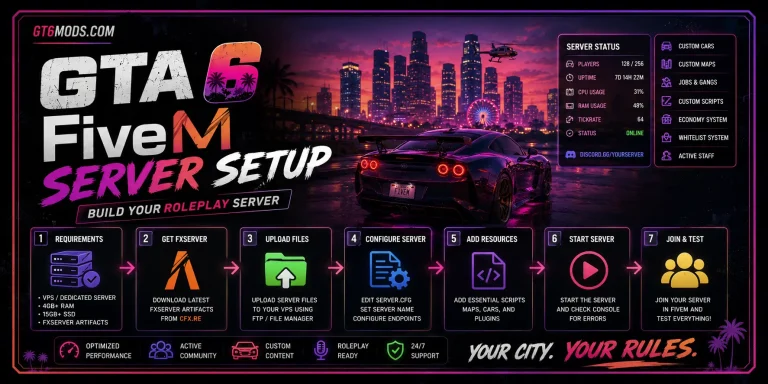
The FiveM project, launched by the Cfx.re team, took GTA 5’s modding potential in a completely different direction. Rather than modifying the single-player game, FiveM created an entirely separate multiplayer framework running on GTA 5’s engine, allowing community-run roleplay servers with their own economies, rules, and scripts. NoPixel became the best-known of these servers and turned GTA roleplay into a mainstream Twitch phenomenon, with major streamers regularly attracting tens of thousands of concurrent viewers. FiveM’s player counts eventually rivaled GTA Online itself on some metrics, representing a genuinely parallel GTA 5 ecosystem that Rockstar hadn’t designed or intended.
The OpenIV Incident of 2017
GTA mods history took a sharp turn in June 2017 when Take-Two’s legal team issued a DMCA takedown against OpenIV, citing concerns that it “enables recent malicious mods that allow harassment of players and interfere with the GTA Online experience.” The GTA community responded with one of the most organized and vocal backlash campaigns in the franchise’s history. A protest mod called “Meltdown” briefly became one of GTA 5’s most downloaded files. The Steam reviews for GTA 5 plunged into “Overwhelmingly Negative” territory within days.
Take-Two reversed course quickly. Within weeks, Rockstar issued its first formal single-player modding policy, explicitly stating that single-player PC mods that don’t infringe on Take-Two’s IP rights and don’t interfere with GTA Online are acceptable. OpenIV was restored. The policy has remained in place ever since, providing the community with more clarity than it had ever had before, while still leaving significant grey areas around which specific types of modding were covered.
The incident is significant because it demonstrated clearly that Rockstar’s real concern was always about GTA Online and its revenue, not about single-player modding. That distinction has defined the community’s relationship with Rockstar ever since.
For the full breakdown of how that policy applies specifically to GTA 6, and what the BattlEye anti-cheat rollout in 2024 means for modders, our guide to modding GTA 6 safely covers Rockstar’s current enforcement approach in detail.
The Malware Problem
April 2015, shortly after GTA 5’s PC launch, saw a different kind of modding crisis: several modification scripts distributed through community sites were found to contain malware keyloggers built in by their creators to steal personal information. This wasn’t Rockstar’s doing, but it permanently highlighted the risk of downloading mods from unverified sources and established why the modding community’s emphasis on trusted distribution channels and verified authors matters.
It’s a lesson that’s directly relevant to the fake “GTA 6 mod” download pages already circulating today, years before GTA 6 has even reached PC.
The Cfx.re Acquisition and What It Means
In August 2023, Rockstar acquired Cfx.re, the company behind FiveM. For anyone who knew that Rockstar had banned FiveM’s developers in 2015 and, according to community accounts, sent private investigators to at least one developer’s home, the acquisition was genuinely remarkable.
Take-Two CEO Strauss Zelnick explained the logic publicly in May 2026: “The way we looked at it is, wow, there are hundreds of thousands of people out there who like to engage with GTA in this way. How about if instead of trying to beat them, we join them?”
The acquisition led directly to the launch of the Cfx Marketplace in January 2026, an official, curated storefront for FiveM and RedM content, with individual assets priced up to $389.99. Parts of FiveM’s previously open-source codebase have been locked down since the acquisition. alt:V, a competing multiplayer mod platform that had run for nine years, shut down in early 2026. The picture that emerges is of Rockstar consolidating the modding ecosystem under its own roof rather than allowing the fragmented, community-driven structure that characterized GTA 5’s modding scene.
Our FiveM GTA 6 breakdown covers this acquisition story in full detail, including what it means for the future of GTA roleplay servers.
GTA 6 (2026 Onwards): A New Chapter With New Rules
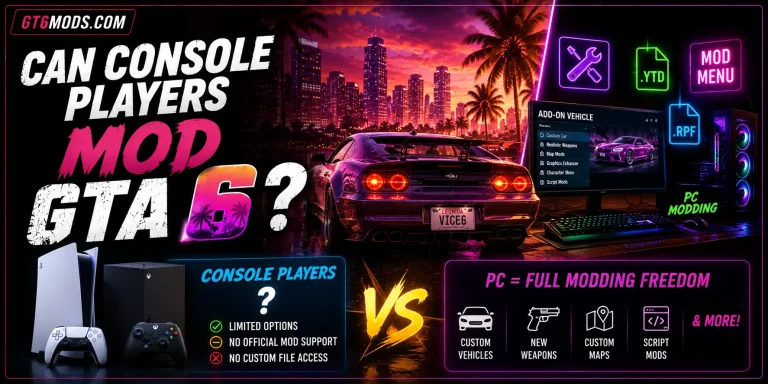
GTA 6 launches on PS5 and Xbox Series X|S on November 19, 2026. No PC release date is confirmed. No modding tools exist for it. The GTA mods history entry for GTA 6 is still being written.
What’s already clear is that the context is different from every previous GTA launch. Rockstar now owns FiveM’s developers. The Cfx Marketplace provides a monetized, official distribution channel for community content. A Creator Platform team has been building officially sanctioned modding infrastructure. BattlEye anti-cheat, rolled out for GTA Online in September 2024, signals serious investment in protecting the online ecosystem well before GTA 6’s PC release.
The single-player modding tolerance that’s protected PC modders for over a decade, built on the back of the 2017 OpenIV incident, seems likely to continue. Rockstar has never reversed that policy, and there’s no credible signal they intend to. But the broader ecosystem of community-created content will be more formalized, more monetized, and more centralized than anything GTA 5 ever had, for better or worse depending on your perspective.
The tools will need to be rebuilt from scratch. Script Hook VI doesn’t exist. An OpenIV equivalent for GTA 6 doesn’t exist. They can’t until the PC version ships and modders can study the code. Based on GTA 5’s timeline, expect basic tools within weeks of PC launch and a fully mature ecosystem six to twelve months after that.
Two decades of GTA mods history have produced one consistent truth: the community always finds a way. The tools change, the platform changes, and Rockstar’s attitude toward modding changes, but the appetite for building on top of what Rockstar creates has never diminished. GTA 6 will be no different.